

College Admissions · What’s Changing in 2026
“Optional” Is Not the Same as “Skip It.” What North Carolina Families Should Know About the SAT and ACT Right Now
Here is a conversation we have a lot at Resource Room.
A parent sits down across from me, a little frustrated, and says some version of the same thing: “The SAT is optional now, right? So why would my kid put themselves through it?” It is a fair question. The word “optional” sounds like a door closing on a stressful chapter. Who would not want that?
“Optional” has quietly turned into one of the most confusing words in the college admissions process, and treating it as “skip it” can cost your student real opportunities. The ground is shifting, and it is shifting back toward testing faster than most families realize. This is especially true for students trying to gain admission into competitive schools, competitive programs, and who are looking for academic merit scholarships.
The pendulum is swinging back, and the most competitive schools are leading
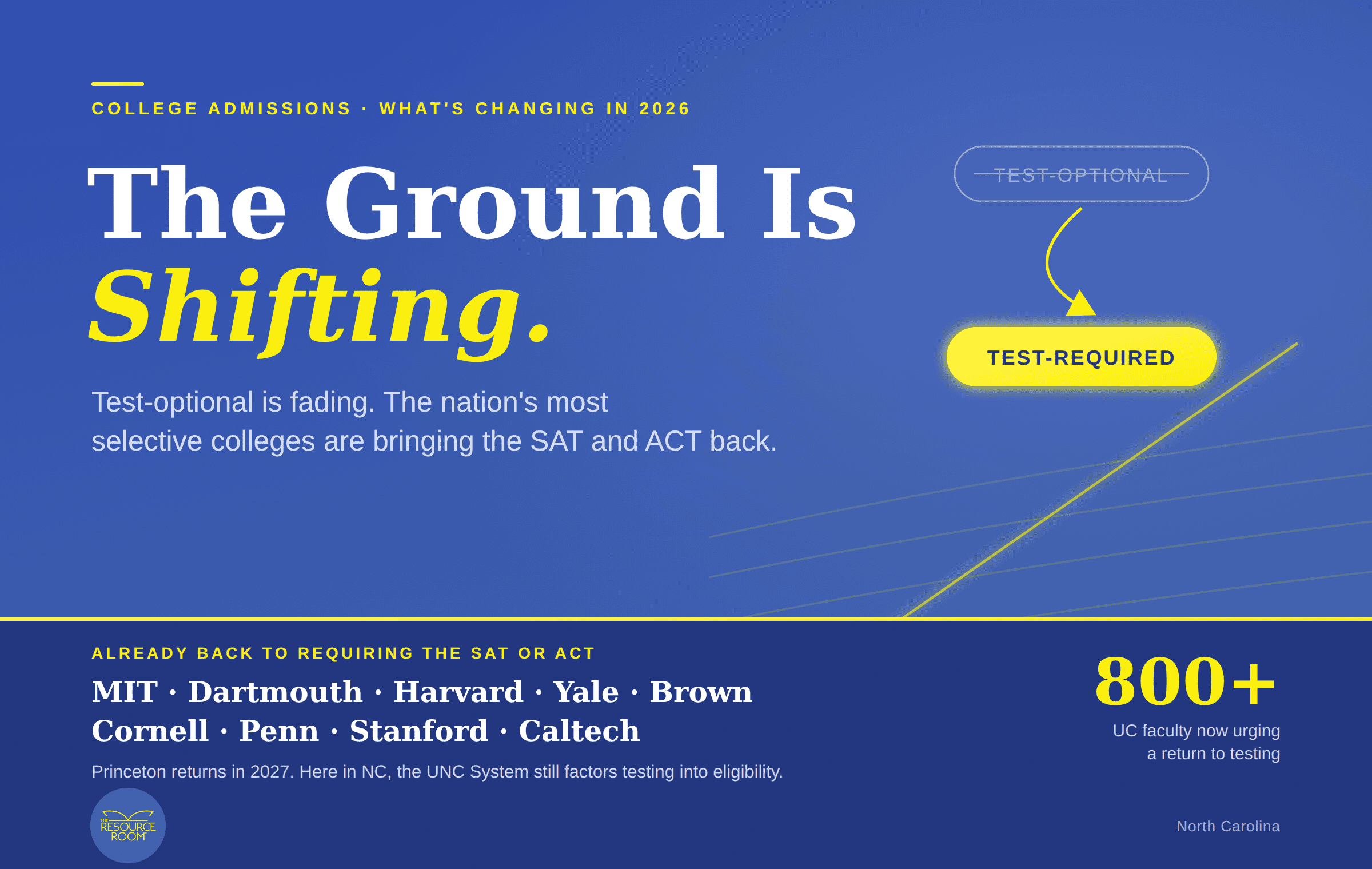
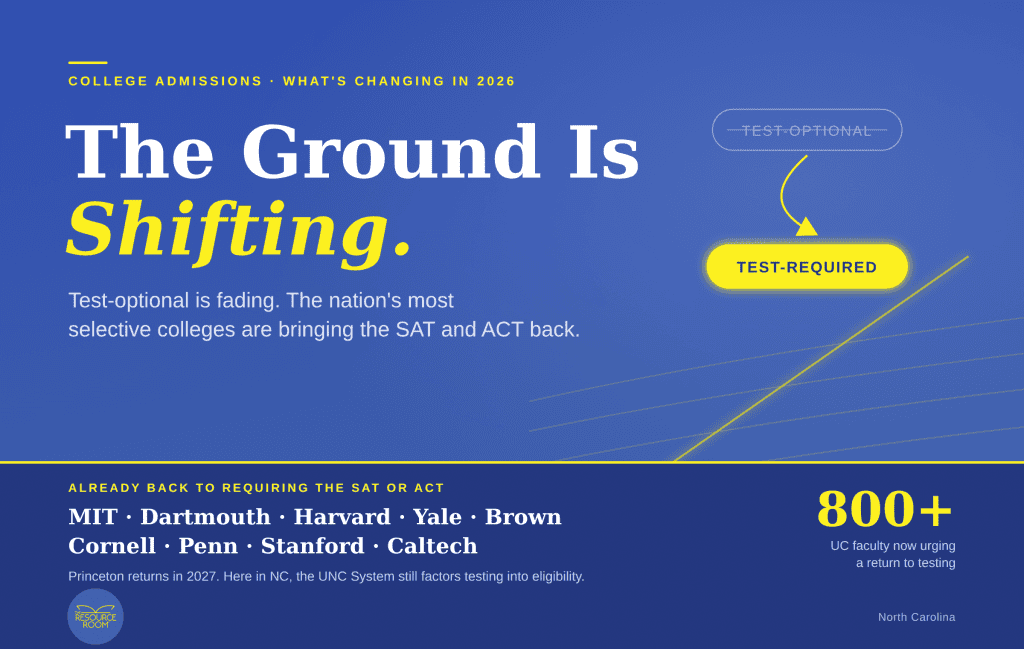
During the pandemic, almost everyone went test-optional. That part you remember. What has gotten far less attention is the reversal. Over the last two years, a long list of the country’s most selective schools has brought the requirement back: MIT, Dartmouth, Harvard, Yale, Brown, Cornell, Penn, Stanford, and Caltech, among others. Princeton returns to requiring scores starting with the 2027 to 2028 cycle. Columbia is now one of the very few holdouts.
These are not random decisions. When MIT brought the requirement back, it said plainly that a requirement is more equitable and more transparent than a test-optional policy. Dartmouth ran its own research and concluded that grades paired with test scores were the most reliable indicators of who would succeed there. Penn said the quiet part out loud: it returned to testing to bring clarity and to remove the uncertainty families felt about whether to submit scores at all.
And just this past week, more than 800 University of California faculty members signed an open letter begging their system to bring testing back for science and math applicants. Their reason should get every parent’s attention. They reported that without scores, they could no longer tell who was ready, and that professors were having to reteach middle-school math to incoming college students.
Why the test earns its place
Here is the part that surprises people. A growing body of research, including a major study of the most selective colleges, found that SAT and ACT scores predicted first-year college grades better than high school GPA did. At those schools, a perfect 4.0 high school GPA predicted college performance only slightly better than a 3.2 did. The test scores carried far more signal.
Why? A big piece of it is grade inflation. When nearly everyone has an A average, grades stop telling colleges much. A test score, taken on the same day under the same conditions, becomes one of the few common measuring sticks left. That is exactly why schools are leaning back into it.
I am not telling you a number defines your child. It does not, and any good admissions office will tell you the same. But a strong score is a piece of evidence that travels well. It speaks for your student in a room where you are not there to advocate.
What this means right here in North Carolina
This is not only an Ivy League story. Look at our own UNC System.
How the UNC System Rules Actually Work
Starting with the 2026 to 2027 year, a student with a weighted GPA of 2.8 or above is not required to submit a test score. A student with a weighted GPA between 2.5 and 2.8 is required to submit one, and must hit at least a 17 on the ACT or a 930 on the SAT to be eligible.
So even in our public universities, testing never fully left. It is woven into the eligibility rules.
Now go one step further, to a campus like UNC Chapel Hill. It is one of the most selective public universities in the country, and its admitted students cluster well above 1400 on the SAT. Technically, a strong-GPA student can apply without a score. Practically, in a pool that competitive, a strong score is one more reason for an admissions reader to say yes. “Optional” on paper does not mean “irrelevant” in practice.
My honest advice to NC parents
Take the test. Plan for it early. Prepare for it seriously.
I say that not because every student needs a perfect score, and not because the test is the only thing that matters. I say it because of how the math of this decision actually works. If your student takes the test and earns a strong score, they hold all their options open. They can submit it where it helps and hold it back where it does not. If your student skips the test entirely, that door is shut. You cannot submit a score you never earned, and you cannot get back the campuses and scholarships where it would have made the difference.
A good score can only help you. A missing score can only limit you. When the choice is framed that way, the smart move gets a lot clearer.
The students who will be caught off guard over the next few years are the ones who heard “optional” and stopped there. The students who will be ready are the ones who treated the test as a tool worth having in their back pocket, even at schools that say they do not require it.
That is the part we love helping families get right.
If you want help building a sensible testing plan for your student, one that fits their goals, their timeline, and the schools they are dreaming about, that is exactly the kind of thing we do at Resource Room. Come talk to us. Let’s make sure your student walks into this process holding every option they can.